Architecture
This page is synchronized from the canonical English documentation. Français navigation is available; commands and product limits are identical in every locale.
Praetor has two layers: the agent runtime (deliberation, topologies, quality gates) and the Architecture V2 governed execution plane (kernel, effect broker, worker plane). This page is a map; the binding decisions live in the repository's ADRs under docs/architecture/.
Deliberation
Every task goes through classification, complexity estimation, and topology selection before any agent runs.
Task classification — six types: FACTUAL, REASONING, CREATIVE, RESEARCH, CODING, ANALYSIS.
Complexity estimation — a score used to size the topology. A one-line task uses one agent; a cross-repository audit can fan out to many.
Topology selection — five canonical topologies:
| Topology | Shape |
|---|---|
SINGLE | One agent handles everything |
CHAIN | Sequential chain of agents (prompt chaining) |
DISPATCH | Parallel agents, then aggregation |
ORCHESTRATOR | Orchestrator delegates to workers |
REVIEW | Generator + evaluator iterative loop |
Legacy names (SEQUENTIAL, HANDOFF, PARALLEL, HIERARCHICAL, HYBRID, DEBATE, ENSEMBLE, EVALUATOR_OPTIMIZER, CONSENSUS) are still accepted and normalized to a canonical parent. The CLI warns once per process per legacy name.
Execution pipeline
Deliberation → Topology router → Agents (LLM → tool → verify)
             → Synthesis → Quality gates → Result
Agent events, tool calls, and gate decisions stream to your terminal or an SSE endpoint as they happen.
Quality gates
Five configured gates can run before a result is returned:
| Gate | Checks |
|---|---|
HALLUCINATION_CHECK | LLM-as-judge detection of fabricated facts |
CONSISTENCY | Cross-agent agreement, no contradictions |
COMPLETENESS | All required dimensions covered |
ACCURACY | Factual correctness against source material |
SAFETY | Content scanning and injection detection |
These gates are checks, not guarantees. If a gate fails, the system retries or reports the failure with context.
Resilience
| Capability | Implementation |
|---|---|
| Circuit breakers | Three-state (CLOSED / OPEN / HALF-OPEN), per-provider error-rate tracking |
| Dead letter queue | Append-only NDJSON, 7 categories, replay support |
| Saga compensation | Registered compensation steps; external rollback is not guaranteed |
| Checkpointing | SQLite + WAL, crash-safe recovery |
| Semantic caching | SHA-256 exact match plus cosine-similarity deduplication |
DLQ categories: llm, tool, execution, verification, circuit_breaker, compensation, semantic_drift.
Architecture V2
V2 splits durable authority from execution so that external writes are governed in one place.
System Architecture & Trust Boundaries
Praetor establishes a strict three-plane isolation model that decouples untrusted agent reasoning from external mutations:
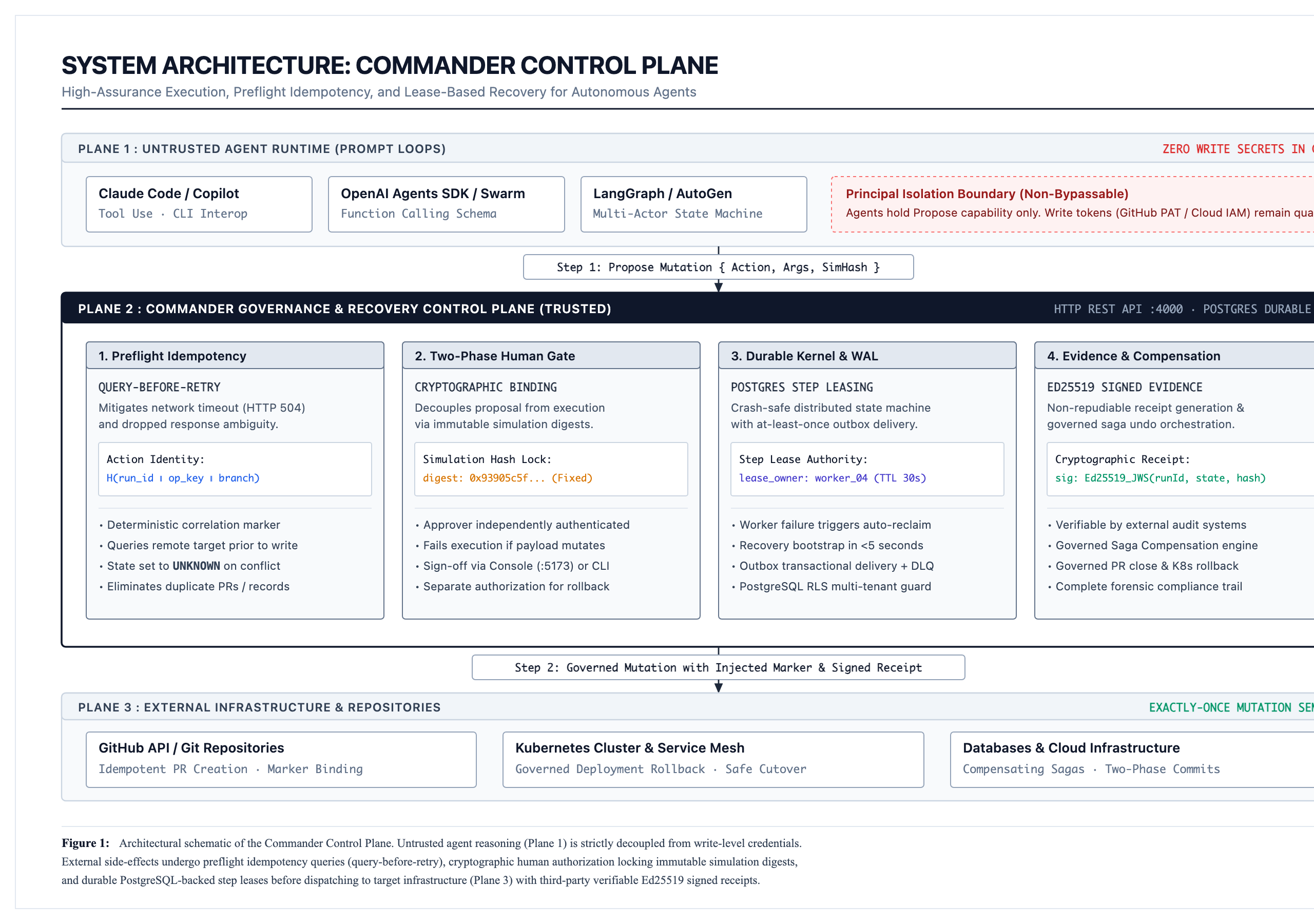
Figure 1: Formal three-plane control architecture. Untrusted reasoning processes are isolated from external write credentials. All consequential mutations require preflight idempotency verification, Ed25519-signed human authorization, and durable WAL step leases before execution.
| Package | Responsibility |
|---|---|
@praetor/contracts | Versioned shared types, error codes, state machine, event envelope, OpenAPI V1. Pure — no runtime imports |
@praetor/kernel | Sole authority for durable run/step lifecycle: leases, idempotency, outbox, recovery, migrations |
@praetor/effect-broker | The only sanctioned path for external writes. Two-phase admit() → executeAdmitted(), Ed25519 capability tokens, policy decisions, quotas, fencing, signed evidence |
@praetor/action-adapters | External-mutation adapters (GitHub pull request, ServiceNow incident, Kubernetes rollback) with conformance test suite |
@praetor/worker-plane | The only place a leased step executes. Fail-closed bootstrap |
@praetor/adapter-ops | Compensation and reconciliation drain daemon |
@praetor/postgres-runtime | Hardened pg.Pool factory: sslmode=verify-full, CA file, SPKI pinning |
@praetor/shadow-plane | Read-only historical policy evaluation for Shadow pilots |
@praetor/core | Agent runtime: orchestration, tools, providers, memory, security, CLI |
@praetor/sdk, praetor-ai | TypeScript and Python clients |
@praetor/mcp-server | MCP stdio server exposing Action Gateway tools |
@praetor/plugin-sdk | Plugin authoring surface |
Governance flow
- A run is submitted to the Gateway (
POST /v1/runs) and persisted by the kernel. - Steps are leased by workers with capability-aware leasing.
- Any step that needs an external write must go through the effect broker, which verifies a capability token, binds the request hash, evaluates policy and quotas, and records signed evidence.
- Consequential actions require approval; approvals are bound to the returned digest and policy snapshot.
- Mutations execute through dedicated action adapters (
@praetor/action-adapters). If response transport is interrupted, the adapter queries external systems for existing outcomes before attempting retries, preventing duplicate mutations. - If a step fails after a partial write, compensation runs through
adapter-opsand is reconciled.
Preflight Query-Before-Retry Protocol
When external writes encounter network drops (e.g. HTTP 504 Gateway Timeout or worker restarts), naive agent retries create duplicate mutations. Praetor executes a deterministic preflight query protocol:
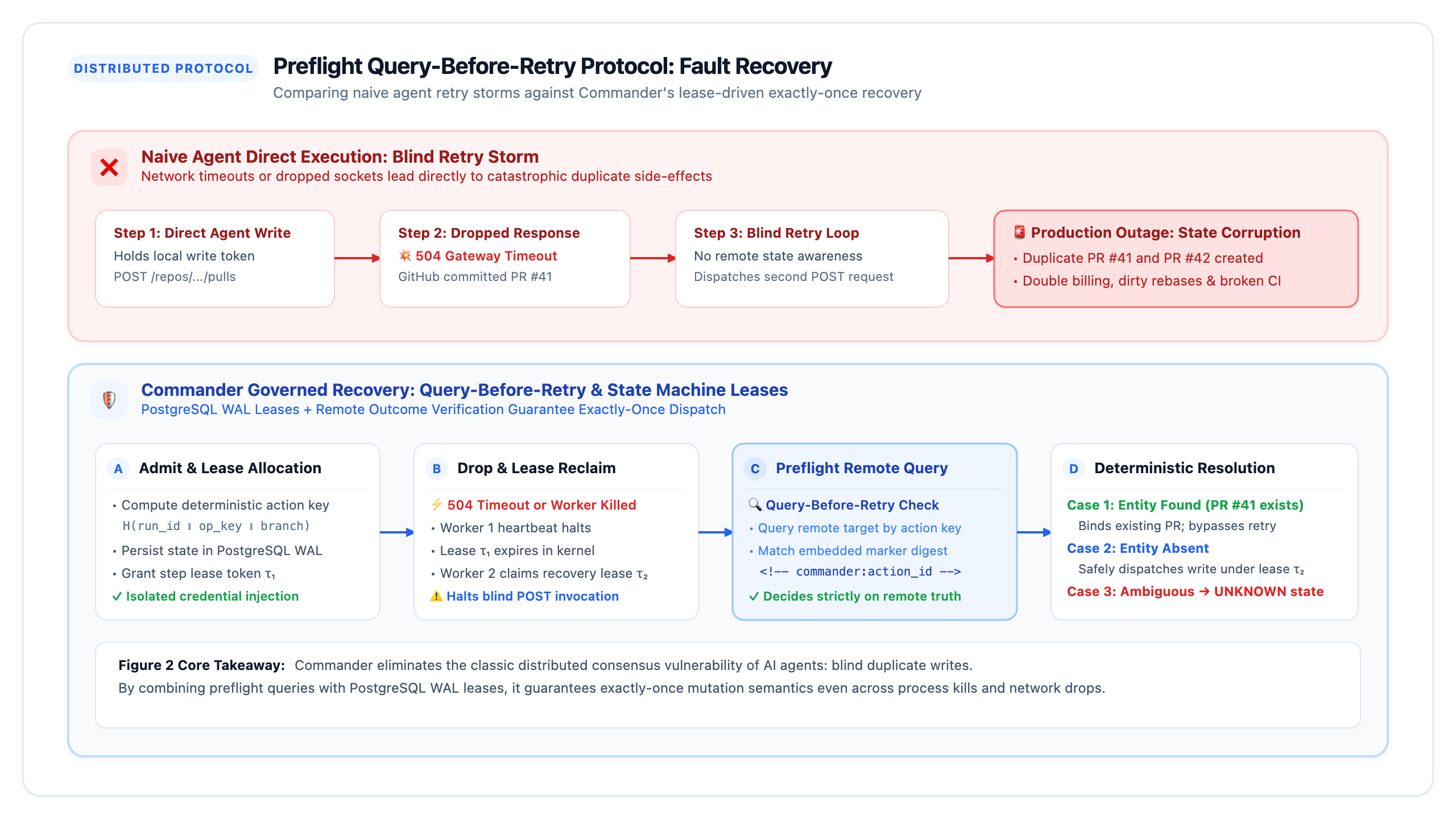
Figure 2: Distributed preflight query-before-retry protocol. Comparing naive agent retry storms with Praetor's lease-driven exactly-once recovery across network timeouts and process crashes.
Two-Phase Cryptographic Human Gate & Evidence Lifecycle
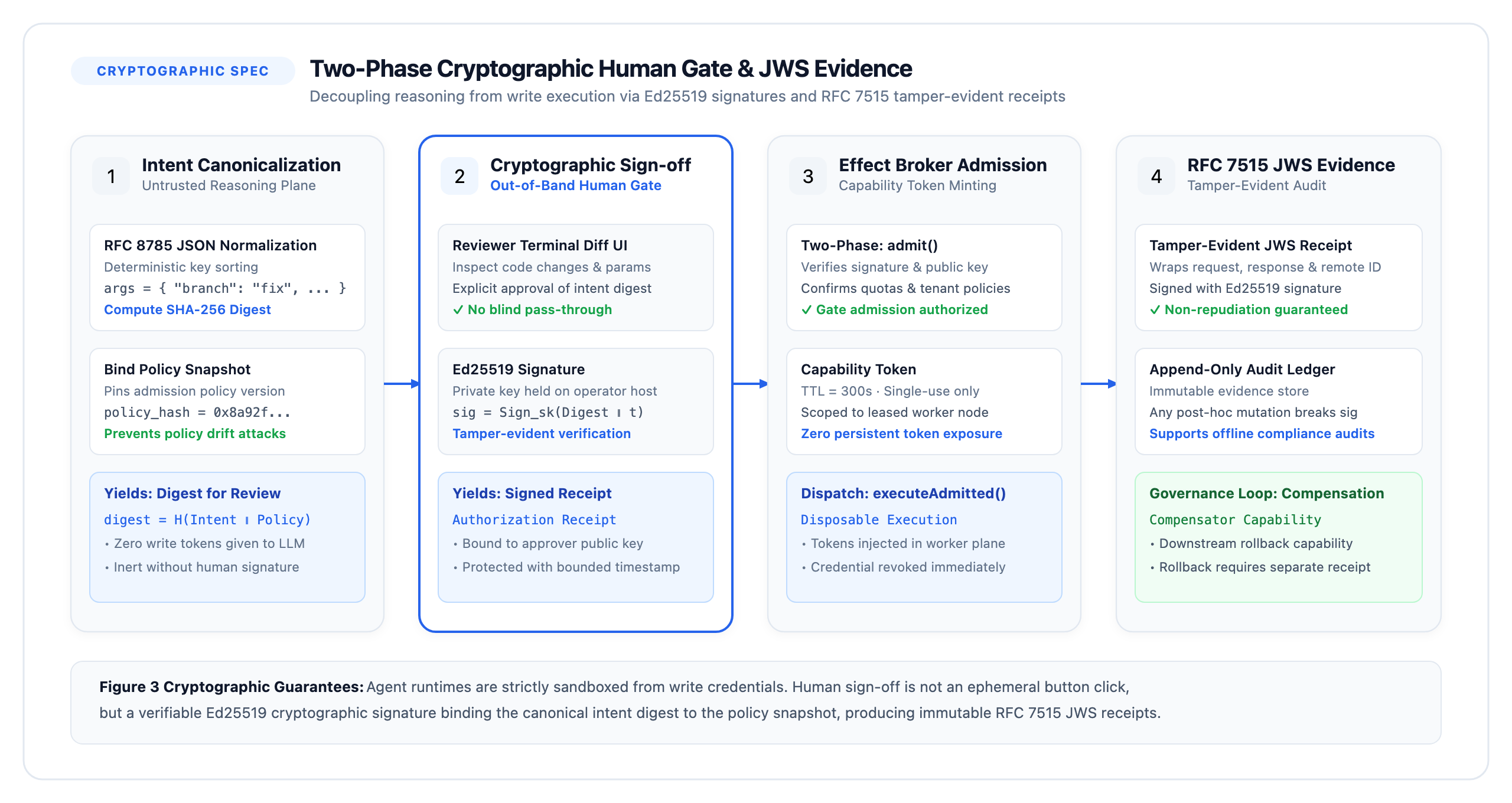
Figure 3: Cryptographic dataflow. The untrusted agent generates a canonical JSON proposal. Reviewers sign the computed intent digest using offline Ed25519 private keys. The effect broker mints an ephemeral capability token, executes through an isolated worker, and emits an immutable RFC 7515 JWS evidence receipt.
Storage and durability
| Layer | Authority |
|---|---|
| API product stores | sqlite (local default), memory, or postgres |
| Kernel | PostgreSQL — runs, steps, events, outbox, leases |
| Local state | .commander_state/ (WAL at .commander_state/event-sourcing.wal) |
In production the API fails closed if no durable store is configured. Local file-backed state is not a multi-replica authority.
Related pages
- Tools — the 18 built-in tools and their trust tiers
- Providers — the 25 providers and the failover chain
- MCP — how external MCP tools enter the runtime
- Security and privacy — capability tokens, evidence, sandboxing
Further reading
docs/architecture/000-index.md— ADR index and feature-freeze rulesdocs/v2-migration-guide.md— migrating to Architecture V2docs/slo.md— SLO definitions- Why retrying an agent external action is unsafe — Failure model: why timeouts are not failures and why blind retries cause duplicate mutations